
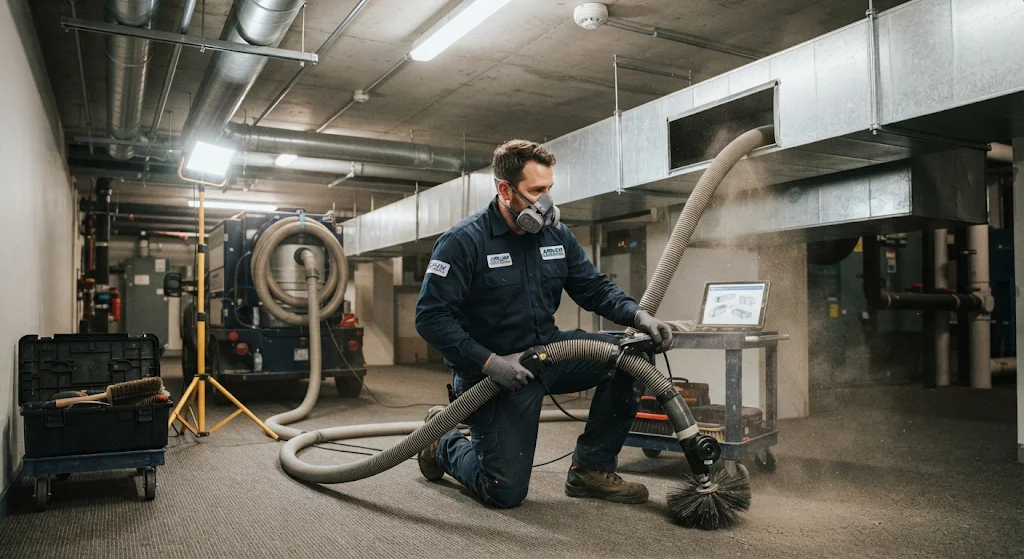
Duct cleaning equipment does more than loosen visible dust: it reaches deep into ventilation networks to dislodge and capture debris that ordinary maintenance can leave behind. From powerful vacuums to precision brushes, each tool has a distinct role in protecting airflow and limiting the spread of contaminants. Understanding how these systems work helps property owners assess what a professional cleaning service should provide.
Equipment That Dislodges and Captures Duct Debris
Effective duct cleaning combines agitation with controlled extraction. A brush or air tool frees material from duct walls, while a vacuum draws it toward a collection unit; without this coordinated process, debris can simply move to another part of the system.
The equipment choice depends on duct dimensions, material, access points, and the type of buildup. Professionals inspect the system before selecting tools, since an approach suitable for a rigid metal trunk line may be inappropriate for a fragile flexible duct.
Vacuum Systems for Controlled Debris Removal
An Air duct vacuum creates suction to collect loosened dust, fibers, and other particles. In many professional setups, a Negative air machine connects to the ductwork and maintains inward airflow, helping prevent disturbed debris from escaping into occupied areas.
Collection quality matters as much as suction. HEPA filtration is designed to capture fine particles in the exhaust stream, while sealed connections and suitable containment practices help keep the work area cleaner during the process.
Brushes and Air Tools for Agitation
A Rotary brush system uses a rotating head to scrub interior surfaces, with brush stiffness and size selected for the duct material. Duct cleaning brushes may also be hand-operated for accessible sections or delicate areas that call for more precise control.
Compressed air tools direct air through specialized nozzles to move debris toward the vacuum inlet. Used with extraction rather than on their own, they can help clean corners, branches, and irregular sections that a brush may not reach effectively.
Methods That Make HVAC Cleaning Effective
Tools work best as part of a planned sequence: inspect, isolate, agitate, extract, and verify. This order supports thorough Debris removal and reduces the chance that loosened material will settle elsewhere in the ventilation system.
Professional providers explain their process and equipment before work begins. Guidance on professional duct cleaning can help clarify what a service may involve, while an overview of expert industrial cleaning services highlights the value of trained operators and specialized machinery.
Inspection and Preparation Before Cleaning
Technicians identify access points, check for visible damage, and determine whether the system contains components that need special handling. They may use cameras or other inspection tools to assess buildup and document conditions, especially where long duct runs limit direct visibility.
Before agitation starts, openings are managed to direct airflow toward the collection equipment. This preparation helps protect nearby rooms and makes the cleaning method more consistent across connected sections.
Verification After Debris Removal
Once cleaning is complete, a follow-up inspection can help confirm that accessible surfaces are clear and that access panels have been properly closed. Any damage or unusual moisture observed during the work should be reported for appropriate evaluation rather than concealed by the cleaning process.
The following equipment comparison shows why no single machine suits every system; the method should match the material, layout, and condition of the ductwork.
| Equipment | Primary Function | Typical Consideration |
|---|---|---|
| Air duct vacuum | Extracts loosened debris | Capacity and filtration must suit the system |
| Rotary brush system | Agitates buildup on interior surfaces | Brush type should match duct material |
| Negative air machine | Maintains inward airflow during cleaning | Connections and containment affect performance |
| Compressed air tools | Moves debris toward the extraction point | Requires coordinated vacuum collection |
Maintenance That Supports Cleaner Airflow
Cleaning equipment is only one part of system care. Regular filter replacement, attention to moisture problems, and scheduled inspections can limit the conditions that allow dust and other debris to accumulate in the first place.
Air duct maintenance should be based on system use, building conditions, and visible need rather than a one-size-fits-all schedule. Excessive or poorly executed cleaning can damage components, so qualified technicians should determine when service is appropriate and which tools are safe to use.
For reliable results, ask providers how they contain debris, what filtration they use, and how they inspect the finished work. The right Duct cleaning equipment, operated as part of a careful process, can support cleaner ducts without treating every system as identical.
Choosing equipment suited to the duct material and pairing agitation with filtered extraction are the foundations of effective cleaning. For system-specific recommendations or specialized service, consult a qualified HVAC professional who can assess the installation and explain the appropriate approach.


