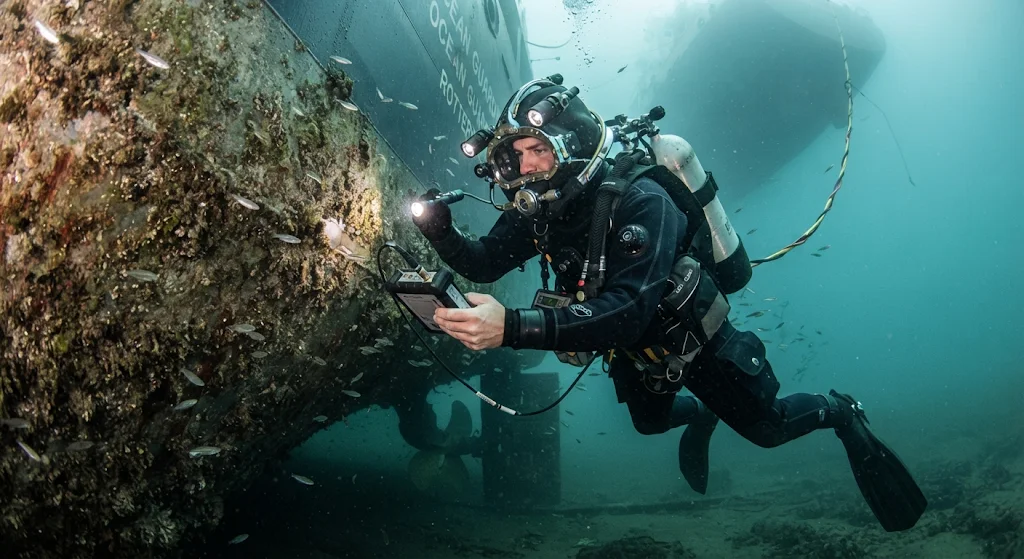
Underwater boat inspections combine a diver’s direct observations with instruments that reveal damage hidden by depth, poor visibility, or marine growth. The right equipment helps survey hulls, propellers, rudders, and fittings while supporting safe communication between the diver and the team at the surface. From basic Scuba gear to remotely operated vehicles, each tool serves a distinct purpose.
Essential Diving Equipment for Boat Inspections
Inspection equipment must support both the diver’s safety and the survey’s objectives. Before a dive, crews consider visibility, water temperature, depth, currents, and the surfaces being examined.
Personal Diving Equipment for Hull Surveys
Standard Scuba gear includes a Dive mask for clear vision and a Regulator that delivers breathing gas from the cylinder. A Buoyancy control device helps the diver maintain a stable position near the hull, reducing unnecessary contact with the vessel.
A Dive computer tracks depth and dive time, while a suitable Wetsuit provides thermal protection. Divers may also carry a Dive light to inspect shaded areas around intakes, appendages, and the underside of the hull.
Surface Support and Diver Location
A Surface marker buoy can indicate a diver’s position to people on the water, subject to the site’s procedures and conditions. On professional operations, a surface team may also monitor communications, manage lines, and record observations as the inspection progresses.
These measures are especially useful around harbors, where vessel traffic, limited visibility, and changing currents can complicate a survey. Clear coordination helps keep the diver oriented and the inspection focused.
Imaging and Detection Tools for Underwater Boat Inspections
When direct observation is limited, imaging and detection systems add another layer of evidence. Their value depends on choosing a tool suited to the target and documenting what it can—and cannot—show.
Camera Systems for Hull and Propeller Checks
An Underwater camera records hull plating, propellers, rudders, and other accessible components. Pressure-resistant housings and sealed connections protect the device, while live video can let surface personnel follow the survey and request closer views of areas of concern.
Consistent lighting and steady movement improve the usefulness of footage. Images can help distinguish visible fouling or coating damage from features that require closer assessment, but a camera alone cannot establish the full extent of concealed structural defects.
Sonar and Remotely Operated Systems
Underwater sonar uses sound waves to map surfaces or identify objects when visibility is poor. It can support checks of submerged hull areas and nearby structures, although results need interpretation in light of the equipment, water conditions, and survey method.
For locations that are difficult or unsafe for a diver to reach, a remotely operated vehicle (ROV) can carry cameras, lights, and sensors. Its tether connects it to a surface operator, enabling controlled observation and real-time transmission of images or data.
The tools commonly selected for a survey can be compared by their primary role:
| Equipment | Typical inspection role | Key consideration |
|---|---|---|
| Underwater camera | Visual records of hulls and fittings | Lighting, image stability, and depth rating |
| Underwater sonar | Mapping in low-visibility conditions | Coverage and operator interpretation |
| ROV | Remote viewing of hard-to-reach areas | Control, tether management, and sensor compatibility |
| Dive light | Illumination of shaded inspection points | Beam strength and battery condition |
Inspection Planning, Equipment Care, and Reliable Findings
Good equipment is only part of a dependable inspection. Survey teams also need a defined scope, suitable operating procedures, and records that make observations understandable after the dive.
Survey Preparation and Documentation
Before deployment, crews should confirm the inspection area, vessel access, communication method, and equipment limits. Recording the location and condition of observed defects—along with clear images where possible—helps maintenance teams compare findings during later surveys.
For a focused hull inspection, the equipment plan may include:
- Personal diving equipment appropriate to depth, temperature, and conditions.
- Camera and lighting systems for documenting visible surfaces.
- Sonar or an ROV when visibility or access limits direct inspection.
- Surface communications and diver-location measures suited to the site.
Maintenance and Professional Oversight
After use, equipment should be rinsed with fresh water and checked for salt, debris, and visible damage. Regular inspection of seals, pressure housings, connectors, and batteries helps identify problems before the next deployment; manufacturer guidance should determine testing intervals and servicing requirements.
Operators need training not only to handle the equipment, but also to interpret its output accurately. For vessel surveys that inform repair or compliance decisions, a qualified marine professional can select suitable methods and explain when further assessment is warranted.