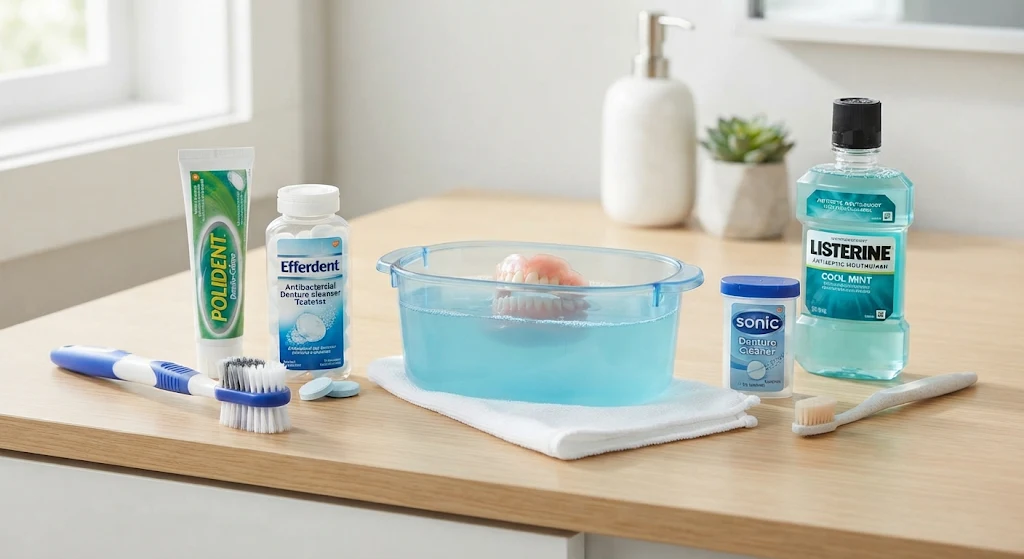
Everyday denture care depends on more than a quick rinse. The right tools can help remove food debris, reduce plaque and odour, and protect the fit and finish of an appliance—while unsuitable products or rough handling may cause damage. Knowing what each item is designed to do makes it easier to build consistent denture hygiene habits.
Denture Cleaning Tools for a Gentle Daily Routine
A denture brush has bristles shaped to reach curved surfaces and grooves without the abrasive force of a standard hard-bristled toothbrush. Brush over a basin partly filled with water or a folded towel beneath the appliance; this reduces the risk of damage if it slips.
Use a product made for dentures rather than ordinary toothpaste, which can be too abrasive for some materials. Clean all surfaces gently, then rinse thoroughly. Brushing removes loosened debris, while soaking can address residue that is harder to reach with bristles alone.
To keep the routine consistent, these basic steps provide a useful framework:
- Rinse the appliance after meals to dislodge food particles.
- Brush it daily with a denture brush and a suitable cleanser.
- Clean the gums, tongue, and palate separately with a soft toothbrush.
- Rinse the appliance fully before placing it back in the mouth.
These habits support cleanliness without relying on force; a careful technique is often more effective than vigorous scrubbing.
Denture Cleansers and Soaking Products
A denture cleanser may be supplied as a liquid, powder, or tablet. Denture cleaning tablets are designed to dissolve in water, while a denture soaking solution can help loosen deposits during the recommended soaking period.
Products differ, so follow the label for dilution, duration, and rinsing. Do not put cleansing solutions in the mouth, and never mix products. Some ingredients may affect metal components or particular denture materials; when the appliance contains metal, check its care instructions or ask a dental professional before soaking it.
A denture cleaning cup keeps the appliance submerged and separate from household items. An ultrasonic denture cleaner uses sound waves to help dislodge debris, but it does not replace brushing or a suitable cleanser. Its compatibility with a specific appliance should be confirmed before use.
| Product | Typical purpose | Care point |
|---|---|---|
| Denture brush | Removes surface debris by brushing | Choose soft, purpose-made bristles |
| Cleaning tablets | Soak-based cleaning | Follow the stated soaking time |
| Ultrasonic cleaner | Helps loosen deposits | Check appliance compatibility |
| Cleaning cup | Holds the appliance during soaking | Keep it clean and rinse after use |
The best choice is the one that suits the denture material and can be used correctly every day.
Denture Storage and Adhesive Removal
When dentures are out of the mouth, keep them moist according to the manufacturer’s instructions. A clean denture storage case helps protect the appliance from dust and accidental knocks; avoid hot water, which may warp some materials, and keep the case itself clean and dry between uses.
For adhesive residue, use a denture adhesive remover intended for the relevant surface, following its directions. Clean remaining adhesive from the gums with a soft brush or gauze, and avoid scraping with sharp objects. Persistent residue, soreness, or a change in fit warrants professional assessment rather than increasingly forceful cleaning.
A complete denture care kit can bring a brush, cleanser, cup, and case together, making the routine easier to maintain at home or while travelling. Product labels and the advice of a dentist or denturist should take precedence, especially for repaired, flexible, or metal-containing appliances.