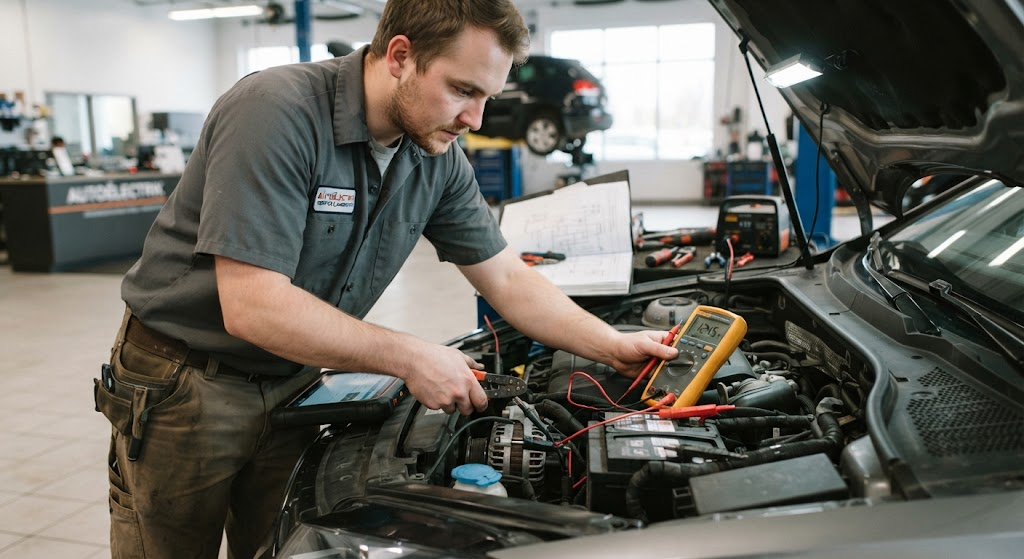
A car that starts inconsistently, flickering headlights, or accessories that suddenly stop working can point to a problem with the battery, alternator, or wiring. Because these parts work together, the same symptom may have several causes, and replacing components without testing can leave the fault unresolved. Understanding how the electrical system supplies and distributes power helps narrow the possibilities.
Diagnose Common Car Electrical Repair Symptoms
Start by recording what happens, when it occurs, and which systems are affected. A no-start, dim lights, dashboard warnings, or multiple malfunctioning accessories can each help distinguish a power-supply fault from a localized circuit problem.
Identify Battery and Starting Faults
A weak or discharged Car battery may cause slow cranking, repeated clicking, or no response when the key is turned. Corrosion or looseness at the terminals can produce similar symptoms by restricting current, so inspect the connections before assuming Battery replacement is necessary.
With the engine off, a fully charged conventional battery typically measures close to 12.6 volts. A low reading suggests the battery needs charging and testing; it does not, by itself, prove that the battery has failed.
Recognize Alternator and Wiring Problems
The Alternator replenishes battery power while the engine runs and supplies electricity to vehicle systems. Flickering lamps, a battery warning light, or repeated battery discharge may indicate a charging fault, including a problem with the Voltage regulator.
Loose grounds, damaged insulation, corrosion, and broken conductors can interrupt power or create shorts. If unrelated systems fail together, shared grounds or wiring deserve attention; Alternator repair should likewise follow testing rather than guesswork.
Trace Electrical System Faults Safely
Once the symptoms are clear, test the simplest shared causes first. A multimeter and an OBD2 scanner can support basic checks, but vehicle-specific wiring diagrams and safe procedures matter, especially around sensitive electronics.
Check Voltage, Fuses, and Grounds
Measure battery voltage with the engine off, then check charging voltage with it running; many vehicles show roughly 13.7 to 14.7 volts while charging, although specifications vary. Inspect fuses only with the correct rating, and never replace a repeatedly blown fuse with a higher-rated one. A blown fuse can indicate a short that must be found.
Look for corrosion, loose battery terminals, damaged ground straps, and visible wire wear. Moisture, heat, vibration, and rodent damage can all compromise Wiring. A multimeter voltage-drop test can reveal resistance in a connection that looks intact.
Use a Logical Diagnostic Sequence
Record fault codes before clearing them, then work from the power source toward the affected component. These initial checks help organize Electrical diagnostics and identify when specialist testing is needed:
- Note which functions fail and whether the fault changes with temperature, vibration, or rain.
- Test battery condition and charging output against the vehicle manufacturer’s specifications.
- Inspect relevant fuses, relays, grounds, connectors, and visible wiring for damage.
- Seek a full-system scan if several control modules report communication faults.
For a focused guide to fuse-related symptoms, see how to handle a blown fuse in a car. Broad service issues may also require qualified automotive repair and diagnostics.
Choose the Right Car Electrical Repairs
Simple cleaning or a confirmed fuse replacement may be manageable for someone with the right tools and knowledge. Airbag circuits, hidden harness damage, repeated fuse failures, smoke, and suspected control-module faults require professional assessment; disconnecting components incorrectly can cause injury or expensive damage.
| Observed symptom | Possible source | Next step |
|---|---|---|
| Slow cranking or clicking | Battery, terminals, or starter circuit | Test battery and inspect connections |
| Lights dim while driving | Charging fault or poor ground | Measure charging voltage and inspect grounds |
| Repeatedly blown fuse | Short circuit or overloaded circuit | Stop replacing fuses and trace the fault |
| Several unrelated systems fail | Shared ground, wiring, or module issue | Arrange professional system diagnostics |
Stop driving if there is smoke or a burning-plastic smell, and arrange recovery rather than investigating a live circuit. A qualified technician can separate a failing battery from alternator or wiring trouble, recommend the appropriate Car electrical repairs, and help prevent the same fault from returning.