
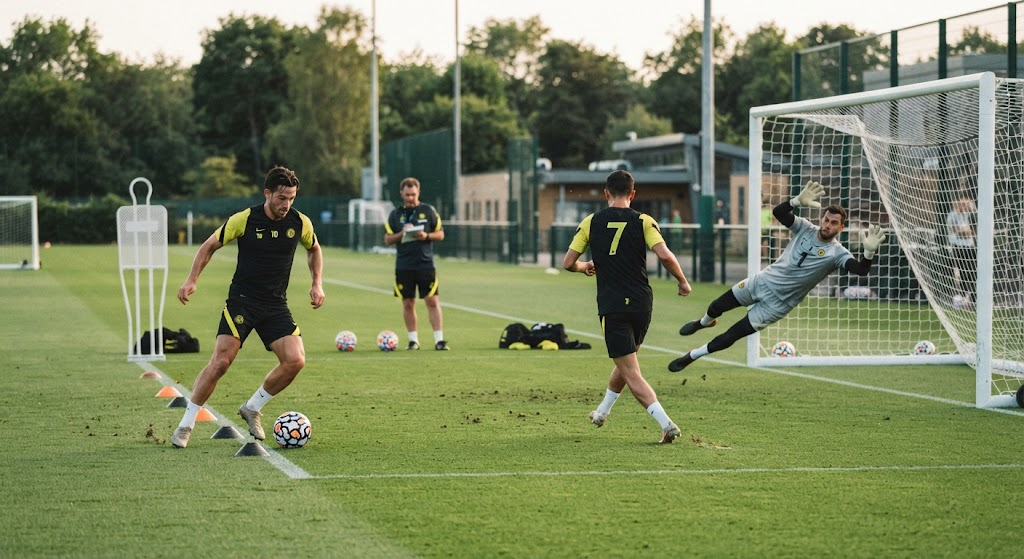
Modern goalkeeping extends beyond stopping shots: keepers must also read danger early and contribute when their team has possession. For outfield players, purposeful work on ball control, dribbling and finishing builds the same foundation of precision under pressure. The most effective programme links these demands through clear objectives, progressive challenges and feedback tailored to the athlete.
Private Training Frameworks for Goalkeeping, Finishing and Dribbling
Private training works best when each session has a defined focus rather than a long sequence of unrelated drills. A coach can assess the player’s current technique, set a measurable objective and adjust the difficulty as execution improves; short individual sessions also make it easier to repeat actions without sacrificing the quality of each repetition.
For goalkeepers, the starting point is often posture, footwork and positioning: these influence whether a save is controlled or rushed. FIFA’s goalkeeper training resources reflect the position’s broader modern demands, combining specialist exercises with analysis and guidance on the techniques keepers need in and out of possession.
For players developing outfield skills, coaches can connect close control to a change of direction, then to a shot or pass. This progression makes soccer coaching more representative of match play, where technique must serve a decision rather than exist in isolation.
Goalkeeping Sessions for Shot Stopping and Distribution
A goalkeeper session should progress from preparation to increasingly game-like actions. The sequence below illustrates how a coach can build reliable technique while keeping the physical workload and decision demands appropriate to the player.
Begin with a dynamic warm-up and basic handling before adding lateral movement, dives and recovery actions. A drill can alternate a low service to one side with a high ball after the keeper returns to their feet; the objective is not simply to reach the ball, but to maintain sound technique through successive efforts.
Goalkeeping Technique and Decision-Making
Effective shot stopping depends on reading the shooter, setting the feet and choosing an appropriate hand position. Coaches should observe whether the keeper moves into line before the strike, keeps the body balanced and directs rebounds away from danger. When these details are secure, add a second attacker or vary the service to prompt faster decisions.
Goalkeeping Distribution Under Pressure
Saving is only part of the role. After securing the ball, the keeper can practise accurate throws, driven passes and decisions about when to play short or long. These actions link technical work to the team’s build-up and encourage scanning before release, an essential habit when opponents press high.
Finishing Sessions for Shooting Accuracy
Finishing practice becomes more transferable when it includes movement before the strike. A player might receive a pass, take a first touch away from a marker and finish with either foot; changing the angle and service prevents repetition from becoming purely mechanical.
Coaches can track shooting accuracy by noting whether attempts reach the intended area, not just whether the ball enters the goal.
A simple progression keeps the purpose clear and lets the player see how each phase adds pressure:
- Practise clean contact and target selection from a stationary position.
- Add a moving pass and a controlled first touch before shooting.
- Introduce a recovering defender or a limited time to finish.
Dribbling Sessions for Ball Control and One-on-One Skills
Close control is most valuable when it helps a player protect the ball, change direction or create space. Cone patterns can refine touches and coordination, but should lead into open-ended challenges in which the player must select a route in response to a defender’s movement.
Develop one-on-one skills by varying the starting position, available space and direction of attack. Encourage the player to approach under control, shift the defender’s balance with a feint, then accelerate into space. The aim is not to perform a move for its own sake; it is to recognise when and where that move can create an advantage.
Dribbling Progressions and Session Design
A balanced individual programme can alternate ball mastery, directional changes and short competitive bouts, with rest and coaching feedback between rounds. For broader development, dribbling work can be combined with passing practice; a structured session for developing passing skills offers a complementary way to train decisions after beating pressure.
| Training focus | Coaching cue | Progression |
|---|---|---|
| Goalkeeping | Set early and stay balanced. | Vary shot direction, height and recovery action. |
| Finishing | Choose the target before striking. | Add a moving pass, defender or time limit. |
| Dribbling | Change pace after creating space. | Move from cones to a live one-on-one. |
Training space also shapes the session: a suitable indoor pitch can support focused technical work when outdoor conditions are unsuitable, as outlined in this guide to indoor soccer facilities in Pinecrest. Across all three skills, consistent feedback and carefully increased challenge help technique transfer to match situations; a qualified coach can tailor individual sessions to a player’s position, experience and development needs.


