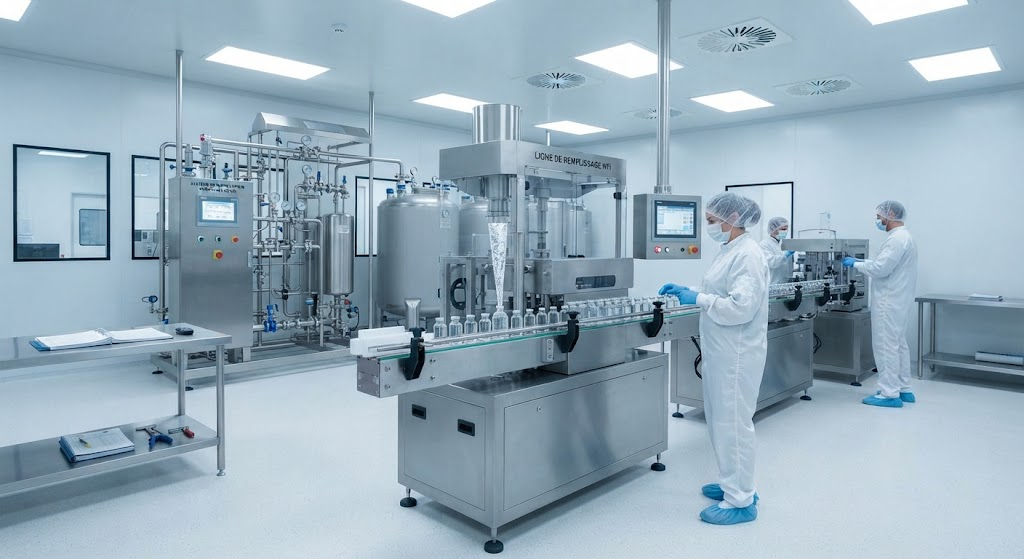
Highly purified water is not simply drinking water with a finer filter: it is water treated to meet the chemical and microbiological requirements of specific commercial processes. Its uses range from pharmaceutical manufacturing and laboratory testing to food production, electronics, healthcare, and facility operations, where dissolved minerals, organic compounds, particles, or microorganisms can affect results and product quality.
Commercial uses for highly purified water across industries
In commercial settings, water purity is a process input rather than a one-size-fits-all amenity. The acceptable level depends on what the water contacts, whether residue could interfere with production, and how tightly the operation must control contamination.
Manufacturing and product quality applications
In pharmaceutical manufacturing, purified water supports preparation, equipment rinsing, and other controlled operations; the required grade depends on the intended use and governing quality requirements. Food and beverage production may use treated water as an ingredient or for cleaning, where mineral content can influence taste, formulation, and equipment performance.
Water with low ionic and particulate contamination also supports electronics manufacturing, where residues left during rinsing can interfere with sensitive components. In cosmetics production, consistent water quality helps limit unwanted deposits and supports repeatable formulations. These applications show why treatment specifications should follow process needs, not a generic label such as “pure.”
Healthcare, laboratories, and facility operations
Laboratory testing relies on water that will not introduce interfering substances into reagents, samples, or analytical procedures. Water specifications vary by method: a routine wash and a sensitive analytical test may require different grades and monitoring.
Hospitals may use purified water for selected stages of hospital sterilization and medical device cleaning, subject to equipment instructions and infection-control protocols. Elsewhere, commercial laundry can benefit from reduced hardness to limit scale and improve washing consistency, while boiler feedwater treatment helps control deposits and corrosion. The common principle is to match water quality to the consequences of contamination.
Purification technologies and application requirements
Commercial purification systems often combine several technologies because each targets different contaminants. System design begins with an assessment of source-water conditions and the required output, then accounts for flow demand, storage, sanitation, and monitoring.
Treatment methods for commercial water systems
Common methods include membrane separation, ion exchange, distillation, particle filtration, and disinfection. Reverse osmosis reduces many dissolved substances, while ion exchange targets particular ions; filtration captures particles, and disinfection controls microorganisms. A sequence of treatments may be necessary when a single step cannot meet the intended specification.
Purity targets and operational controls
Before choosing equipment, facilities should define measurable quality parameters and verify them where water enters the process. Depending on the application, monitoring may include conductivity or resistivity, total organic carbon, particle levels, and microbiological indicators. Applicable industry standards and equipment manufacturer guidance should determine acceptance criteria.
Useful planning checks include the following, since each can affect both performance and reliability:
- Identify the process points where water contacts products, equipment, or analytical samples.
- Characterize incoming water and account for seasonal or operational changes.
- Specify required quality at the point of use, not only at the treatment outlet.
- Plan routine testing, sanitization, filter replacement, and corrective action.
These controls help distinguish verified process water from water that merely passes through purification equipment.
Commercial water system selection and maintenance
A treatment system should be sized around actual demand, including peak flow and periods of low use. Excess capacity can increase stagnation risks, while insufficient capacity may disrupt production or encourage bypassing controls.
System design, efficiency, and upkeep
Designers consider source-water variability, required purity, operating schedule, reject streams, and downstream distribution. Some purification methods consume additional water during backwashing or reject-water production, so efficiency should be evaluated alongside output quality. Recovery and reuse options may reduce waste where local regulations and process requirements permit.
Commercial water applications at a glance
The table summarizes common uses and the main quality concern to assess; it is not a substitute for application-specific standards or validation.
| Commercial application | Typical purpose | Quality consideration |
|---|---|---|
| Pharmaceutical manufacturing | Preparation and equipment rinsing | Defined chemical and microbiological controls |
| Laboratory testing | Reagents, analytical procedures, and rinsing | Purity grade suited to the test method |
| Electronics manufacturing | Component rinsing | Low residue and contaminant levels |
| Boiler feedwater | Steam generation support | Control of scale-forming minerals and corrosion |
| Medical device cleaning | Selected cleaning or final-rinse stages | Compatibility with validated instructions |
Ultimately, dependable purified water comes from aligning treatment, distribution, and verification with the task at hand. A qualified water-treatment professional can assess site conditions, applicable requirements, and maintenance needs to recommend a suitable system.