Interlocking pavers succeed or fail below the visible surface. A stable installation depends on two systems working together: edge restraints that contain the paving field and base materials that distribute loads, manage water, and limit movement over time. Choosing components is not simply a matter of following a standard recipe.
Choosing Edge Restraints for Interlocking Pavers
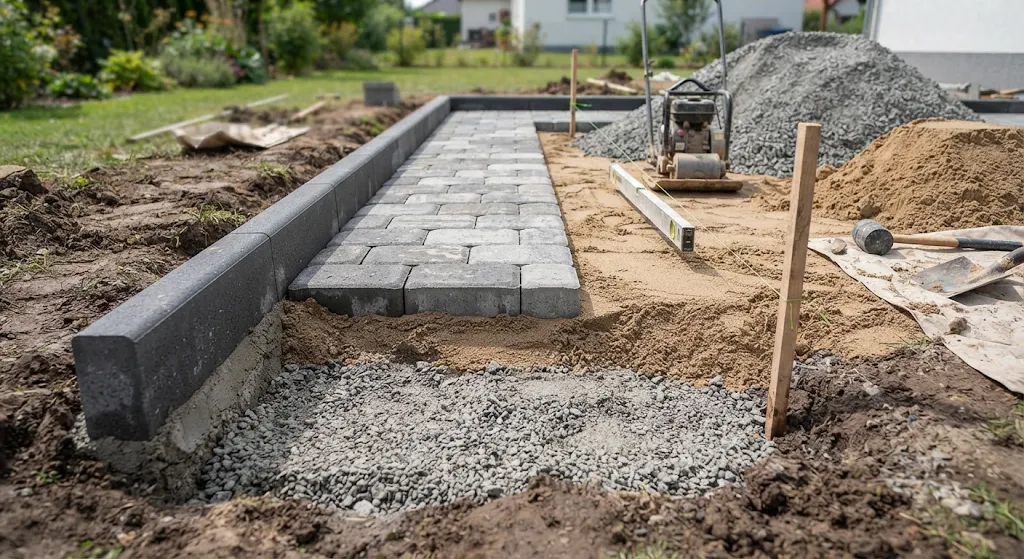
In interlocking projects, edge restraints hold the outside courses in place, resisting the sideways forces created by foot traffic, vehicles, and repeated freeze-thaw cycles. Without firm containment, joints may widen and pavers can creep outward, even when the surface appears level at installation.
The restraint should suit the project’s shape, exposure, and load. Before selecting a material, consider how it will be anchored and whether it can follow curves without losing support.
Selecting Restraint Materials and Anchoring
Plastic edging is lightweight and flexible, making it useful for curved garden paths and many residential layouts. It must be secured with suitable spikes and supported by a compacted base; a loose or poorly anchored strip cannot reliably contain the paving.
Concrete or metal restraints can provide a more rigid boundary in particular settings, but their suitability depends on the design and site conditions. Whatever the material, the restraint should sit low enough to avoid obstructing the finished surface while still firmly supporting the outside pavers.
Matching Edge Support to Loads
Walkways and patios generally experience less stress than driveways, where turning tires can exert strong lateral pressure. For vehicle areas, the edge detail and base must be designed as a coordinated system rather than treated as separate finishing choices.
Transitions to lawns, planting beds, or existing paving also deserve attention: unsupported edges can allow soil to spill into joints or create a path for water. A secure perimeter preserves alignment and helps the surface remain orderly.
With the perimeter established, the next decision is the layered foundation beneath the pavers.
Building a Stable Base With the Right Materials
Base materials carry the load and provide a consistent platform for the paving. A common assembly uses a compacted aggregate base, a thin bedding layer, and joint material, but depth and composition should reflect soil strength, drainage, climate, and expected use.
Excavation and grading matter as much as the materials themselves. The prepared area should direct water away from structures, and each layer should be compacted evenly to reduce later settlement.
Comparing Gravel Base and Crushed Stone
A gravel base is a broad term that can describe aggregates with different particle sizes and shapes. Well-graded, compactable material helps create a dense foundation; poorly selected or uneven aggregate may leave voids that contribute to movement.
Crushed stone has angular particles that interlock under compaction, making it a common choice for paving foundations. The appropriate aggregate and layer thickness depend on site conditions, so local specifications and professional judgment should guide the design rather than a universal depth.
Placing Bedding Sand and Joint Material
Bedding sand creates a thin, even setting layer that allows pavers to be adjusted into alignment. It is not a substitute for a structural base: an overly thick or inconsistent sand layer can shift under load and produce dips.
After placement, jointing material fills the spaces between units and supports paver joint stabilization. The right product and installation method depend on the paver system and exposure to water; follow manufacturer guidance and avoid washing material out during cleanup.
The layers work together, but each has a distinct job. This comparison helps clarify what to assess before construction begins.
| Component | Primary Function | Key Consideration |
|---|---|---|
| Edge restraint | Contains the paving perimeter | Anchoring and load exposure |
| Aggregate base | Supports loads and promotes drainage | Soil, compaction, and intended use |
| Bedding sand | Levels pavers into a uniform plane | Keep the layer consistent and thin |
| Joint material | Fills gaps and helps limit movement | Compatibility and water exposure |
Coordinating Installation for Lasting Performance
Good paver installation depends on sequencing: prepare and compact the subgrade, place and compact the base in manageable lifts, screed the bedding layer, then lay and cut the pavers. Installing edge restraints at the appropriate stage helps lock the field in place without disturbing its alignment.
Before work begins, check drainage routes, utility locations, boundary details, and product instructions. A qualified paving professional can assess conditions that are difficult to judge from the surface and recommend a system suited to the site.
- Confirm that excavation depth accounts for every planned layer.
- Check that slopes direct runoff away from buildings.
- Compact aggregate evenly rather than relying on a single pass over a thick layer.
- Match restraints and jointing materials to the paver system and expected loads.
Reliable interlocking surfaces come from compatible materials, sound drainage, and precise installation—not from any single product. For tailored recommendations or specialized work, consult a qualified paving professional familiar with local soil and climate conditions.