
As education evolves, parents often grapple with a pivotal choice: the International Baccalaureate (IB) curriculum or traditional education systems. Both avenues promise unique benefits, yet they offer vastly different experiences that can shape a child’s learning journey and future opportunities. This exploration delves into the core distinctions, illuminating how these two educational philosophies cater to diverse learning styles and aspirations.
Understanding the IB Curriculum
The International Baccalaureate (IB) curriculum is renowned for its comprehensive and student-centered learning approach. Unlike traditional education systems, which typically emphasize rote learning and standardized assessments, the IB framework encourages inquiry and the application of knowledge across various disciplines. This integrated approach not only fosters critical thinking but also enhances cultural awareness and prepares students for a globalized world. The IB curriculum includes several programs tailored for different age groups, ensuring a cohesive educational experience from early childhood through pre-university level.
Holistic Development in IB Schools
At the heart of the IB philosophy is a commitment to holistic development. This entails not just academic growth but also personal and social development. IB programs integrate community service, physical education, and arts, promoting well-rounded students who are not only knowledgeable but also socially responsible. For instance, students might engage in projects that address real-world issues, thereby enhancing their learning while making a positive impact on society.
Comparing Learning Approaches
The distinction between IB schools and traditional education largely hinges on their respective learning approaches. IB schools adopt an inquiry-based methodology, while traditional systems typically follow a linear path, focusing on memorization and predefined answers. In an IB classroom, students actively explore and connect concepts across various subjects, making learning more relevant and engaging.
Experiential Learning
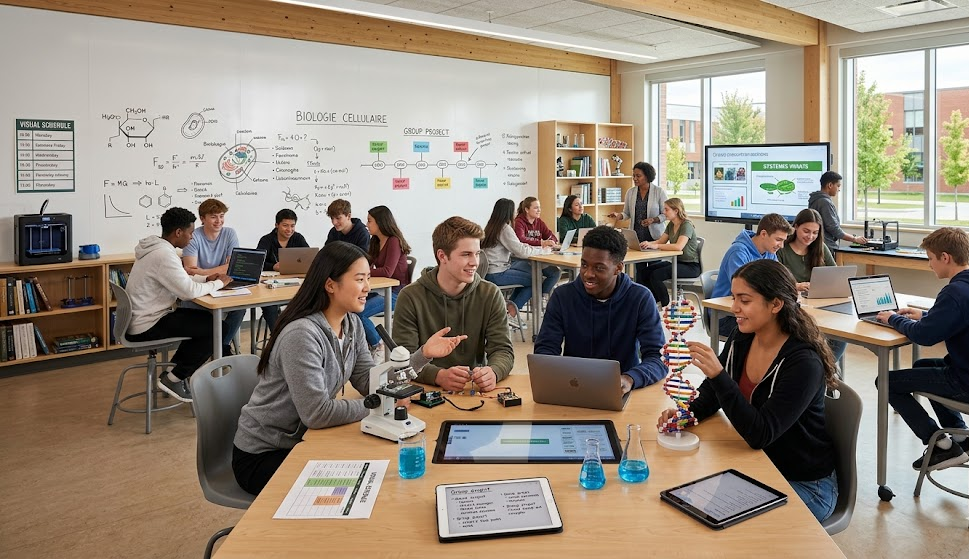
In IB education, experiential learning plays a significant role. Students are often involved in hands-on projects, simulations, and collaborative activities. This contrasts sharply with the traditional system, where students may primarily learn through lectures and textbooks. For example, while an IB student might work on a science project that requires them to conduct research and experiment with real-world applications, a student in a traditional school might primarily study definitions and theory.
Assessment Methods Explained
Another pivotal difference lies in how students are assessed. The IB curriculum emphasizes continuous assessment over high-stakes testing. This means that assessments are integrated into daily learning and include projects, presentations, and internal evaluations. This method allows for a more nuanced understanding of a student’s abilities and development over time.
Pressure and Achievement
In traditional education, assessment often culminates in final exams that heavily dictate a student’s academic outcome. While high-stakes testing can create significant pressure, the IB model seeks to alleviate this burden by distributing assessment throughout the academic year. However, it should be noted that IB students are still required to maintain a consistent effort, reflecting a form of academic rigor that is equally demanding, albeit structured differently.
Teaching Styles and Classroom Dynamics
The teaching style in IB schools promotes interactive learning. Teachers serve as facilitators, guiding discussions and encouraging independent thought among students. This contrasts with the traditional approach, where teachers often lead the classroom with a focus on structured instruction and delivery of core content.
Interaction and Engagement
In IB classrooms, dialogues between students and teachers are encouraged, fostering an environment where questioning and exploration are part of the learning process. Traditional classes, by contrast, may emphasize a more passive reception of information, where students are primarily learners rather than active participants. This shift in dynamics can significantly impact how students retain information and develop critical life skills.
Curriculum Structure and Flexibility
The structure of the IB curriculum is distinctly more flexible and interdisciplinary compared to traditional education systems. IB education encourages connections among subjects, enabling students to understand topics in broader contexts. This curriculum engages learners to synthesize knowledge from various domains, facilitating a deeper comprehension of the interconnected nature of knowledge.
Benefits of Interconnected Learning
This interdisciplinary approach not only enhances critical thinking but also prepares students for the complexities of real-world challenges. In contrast, traditional schools often adhere to rigid subject boundaries, which can limit students’ ability to see the larger picture. The flexibility of the IB curriculum allows for a more relevant and applicable educational experience.
Preparing Students for the Future
Ultimately, the choice between IB and traditional education should align with a child’s unique learning style and future aspirations. For families seeking a globally recognized education that emphasizes holistic development and critical thinking, the IB framework offers a compelling option. However, traditional schools also produce well-rounded individuals ready for local or national academic environments.
Both educational paths are valuable in their own rights. By considering each approach’s strengths and weaknesses, parents can select the best environment for their child’s educational journey, fostering not only academic success but also personal growth.


