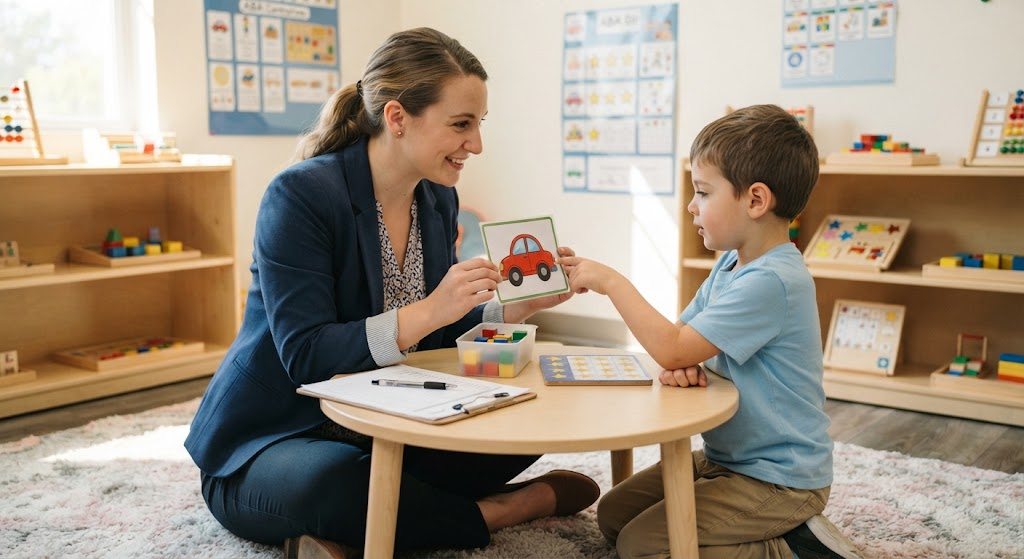
A behavior plan for an ABA child should describe skills and behaviors in terms that families, clinicians, and educators can understand and measure. Clear goals connect assessment findings to meaningful outcomes, while helping the team determine whether teaching strategies are working.
ABA Behavior Plan Foundations for Meaningful Goals
Before writing behavioral objectives, a Board Certified Behavior Analyst (BCBA) gathers information about the child’s current abilities and priorities. Assessment may include direct observation, caregiver interviews, record reviews, and structured tools such as the VB-MAPP, ABLLS-R, or AFLS. When challenging behavior is a concern, a Functional Behavior Assessment (FBA) can help identify patterns and develop a hypothesis about what may be maintaining it.
Baseline data show what happens before an intervention begins. The team can then choose a measurement method that fits the target: frequency for countable events, duration for behaviors that last over time, or accuracy for a developing skill. A baseline is a starting point, not a judgment about the child.
Strong goals are specific, measurable, achievable, relevant, and time-bound. For instance, “request a break using speech, sign, or AAC in four of five observed opportunities over four consecutive sessions” identifies a response, measurement criterion, and review period. By contrast, “be more cooperative” leaves too much room for interpretation.
Measurable Goals and Behavior Plan Components
A useful plan explains not only what the child is learning, but also how supporters will teach and assess it. Each target should be understandable to the people implementing the plan, including family members and school staff. The table outlines the core elements that make a goal trackable.
| Plan Element | Purpose | Example |
|---|---|---|
| Target behavior | Defines the response in observable terms | Asks for help using a word, sign, or AAC message |
| Context | Clarifies when the skill is expected | During a task the child cannot complete independently |
| Measurement | Shows how performance will be recorded | Independent requests in each opportunity |
| Criterion and timeframe | States when the goal will be reviewed as mastered | Four of five opportunities across three sessions |
| Generalization | Checks whether the skill transfers beyond teaching | With different people and at home and school |
When a plan addresses behavior that interferes with learning or safety, goals to reduce it should be paired with a skill that serves a similar purpose. A child who screams during transitions might be taught to request more time or ask for help. Positive reinforcement can support the new response when it is effective and appropriate, while preventive strategies—such as visual schedules—may make transitions more predictable.
Progress Monitoring and Family Participation
Ongoing data collection helps the BCBA judge whether instruction should continue, change, or move to a new target. Progress monitoring may include session records, graphs, and periodic written summaries. If data show little improvement, the team should review the teaching method, measurement, setting, and relevance of the goal rather than simply leaving it unchanged.
Family participation strengthens the plan because caregivers understand which skills matter in daily routines. Ask why a target is a priority, how mastery will be defined, what progress looks like compared with baseline, and how a skill will be practiced across settings. A goal that is unclear or does not fit family priorities deserves a straightforward discussion.
Review goals regularly as the child’s needs and abilities change. A skill demonstrated in a clinic may require additional teaching to occur at home, school, or in the community; maintenance checks can show whether it lasts over time. The plan should remain practical, respectful, and responsive to the child’s assent and preferences.
A sound ABA behavior plan turns assessment into clear, socially meaningful goals, with observable responses, appropriate measures, and regular review. For individualized guidance or specialized intervention, consult a qualified BCBA who can work collaboratively with the child and family.