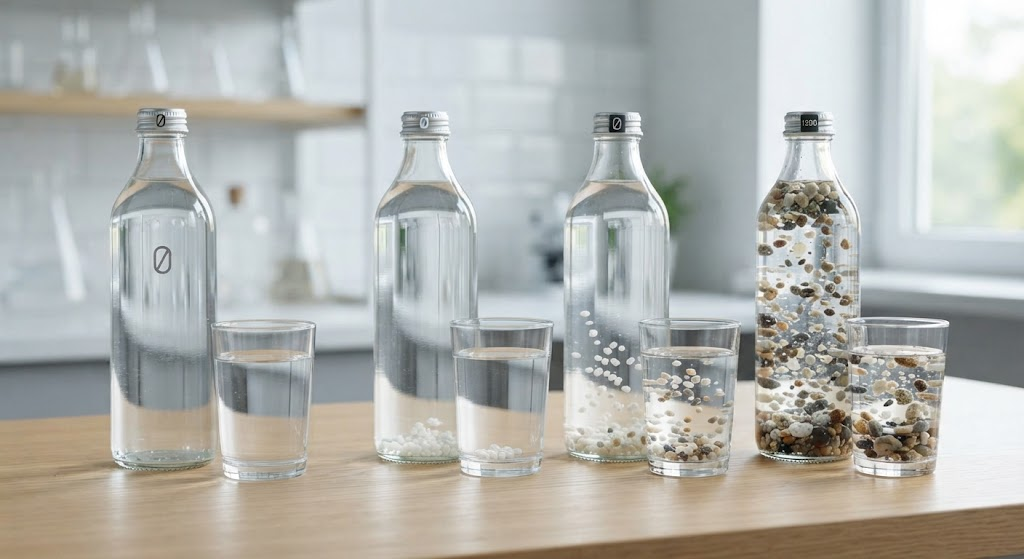
Minerals give ordinary water much of its character, but in boilers, laboratories and sensitive manufacturing processes, even small amounts can leave deposits or interfere with results. Demineralised water is produced to control those dissolved substances; its value lies not in being universally superior, but in matching its mineral content to a defined use. Understanding how minerals affect water quality helps explain why treatment systems combine different technologies.
Mineral Content and the Purpose of Demineralised Water
Water acquires dissolved substances as it moves through soil and rock. Calcium, magnesium, sodium, silica and other ions contribute to total dissolved solids (TDS), while their concentration can influence hardness, conductivity, taste and the formation of scale.
Demineralised water has had most dissolved mineral ions removed. Unlike a standard sediment or carbon filter, which mainly targets particles, odours or particular chemicals, demineralisation changes the concentration of dissolved ions.
Two practical effects explain why this treatment is used. First, limiting scale can help protect boilers and heat-transfer equipment; second, reducing variable mineral concentrations can support consistent laboratory work and product manufacturing.
Mineral Effects on Equipment and Processes
When mineral-rich water is heated or concentrated, some compounds can precipitate and form deposits on pipes, membranes and boiler surfaces. These deposits can restrict flow and reduce heat-transfer efficiency, while changing water chemistry may also contribute to corrosion in certain systems.
In pharmaceuticals and electronics, unwanted ions can affect product purity or interfere with tightly controlled production steps. Demineralised water therefore provides a more predictable starting point, though each application still needs its own water specification.
Mineral Removal Versus Water Softening
Softening generally targets hardness ions such as calcium and magnesium, often exchanging them for sodium. Demineralisation removes a broader range of charged minerals, but does not necessarily remove every microorganism, organic compound or suspended particle; treatment may need multiple stages.
For a broader look at purity methods, this guide to assessing water purity provides useful context. The key distinction is that clarity alone does not reveal the full ionic composition of water.
Treatment Methods and the Mineral Content They Control
The appropriate process depends on incoming water, required purity, flow rate and operating conditions. Industrial systems commonly combine technologies because no single method addresses every contaminant equally well.
Reverse Osmosis and Ion Exchange
Reverse osmosis (RO) applies pressure to move water through a semi-permeable membrane, reducing dissolved salts and many other contaminants. Performance varies with feed-water quality, membrane condition and system design, so pretreatment and routine monitoring help maintain reliable output.
Ion exchange uses resins that exchange dissolved cations and anions for hydrogen and hydroxide ions. It can produce water with very low ionic content, but conventional resin systems require regeneration or replacement; electrodeionization (EDI) combines ion-exchange materials with an electric field to remove ions continuously, typically after RO pretreatment.
Distillation and Combined Treatment
Distillation evaporates water and condenses the resulting vapour, leaving most non-volatile minerals behind. It can be effective, although energy use and the possibility that certain volatile compounds travel with vapour mean that system design and additional treatment may matter.
In practice, treatment trains may include pretreatment, RO and polishing by ion exchange or EDI. An overview of steam distillation illustrates how this traditional separation process differs from membrane-based treatment.
| Method | How it reduces minerals | Operational consideration |
|---|---|---|
| Reverse osmosis | Membrane separation under pressure | Requires membrane cleaning and monitoring |
| Ion exchange | Replaces dissolved ions using resin | Resin needs regeneration or replacement |
| Distillation | Separates water vapour from most minerals | Requires heat and scale management |
| EDI | Uses electricity and ion-selective materials | Usually integrated with pretreatment |
Water Quality, Drinking Water and Mineral Balance
Low mineral content is beneficial for many technical tasks, but it does not make water inherently healthier or suitable for every purpose. Drinking water choices should account for contaminant testing, local standards, taste preferences and the overall diet.
Essential Minerals and Health Considerations
Food is generally a major source of essential minerals, while drinking water can contribute varying amounts depending on its source. Demineralised water contains fewer minerals, but claims about specific health benefits or harm should not be made without considering the person’s diet, health and water-treatment context.
Removing minerals also changes taste and buffering capacity. Water remineralisation may be used after purification to adjust taste, alkalinity or mineral balance where required; it is a process-control decision, not a universal requirement. Electrolyte levels in the body are regulated through several physiological systems and are not determined by water alone.
Testing and Application-Based Specifications
A TDS meter offers a quick estimate of dissolved solids, but it does not identify which substances are present. Laboratory analysis and measurements such as conductivity are more informative when a process requires a defined purity target.
Before selecting treatment, specify the intended use, source-water composition and required monitoring points. For industrial systems, specialist guidance can help match treatment stages to operating needs; this overview of water-treatment solutions offers further perspective on system selection.