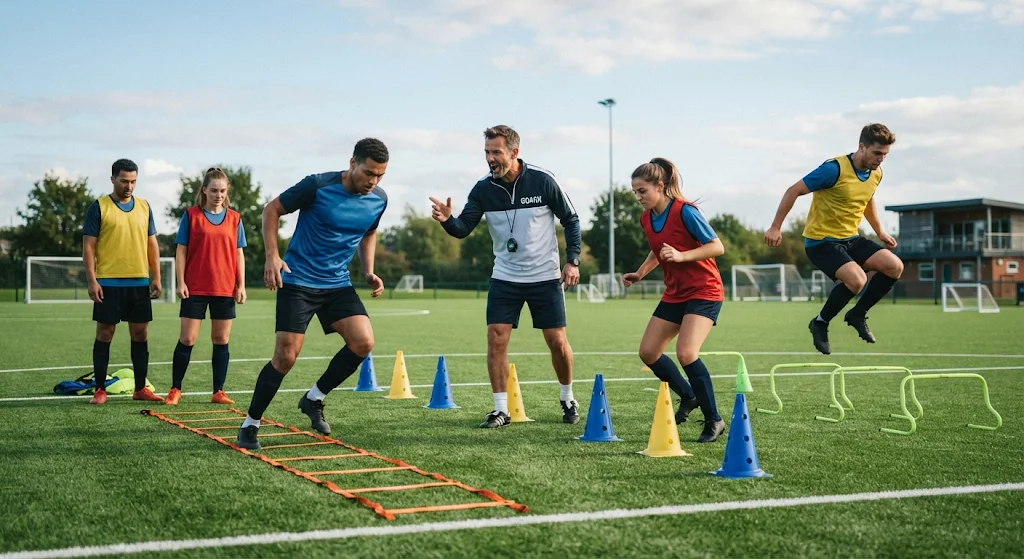
Speed and Agility Drills in Football Physical Preparation help players accelerate into space, react under pressure, and change direction without losing balance. These qualities depend on more than running fast: effective preparation combines sound technique, strength, coordination, and carefully managed effort. A well-designed program develops match-relevant movement while allowing enough recovery for each repetition to stay sharp.
Movement Foundations for Football Speed and Agility
Football demands repeated bursts over short distances, often after a visual cue or a change in the play. Training should therefore connect Acceleration, Sprint mechanics, and Change of direction rather than treating them as isolated abilities.
Early acceleration benefits from a forward body angle, forceful arm action, and progressive steps that push the ground behind the player. As speed increases, the torso rises and strides become more upright; attempting to stay low throughout can restrict efficient running mechanics.
For agility, movement quality begins before the turn. Players need to lower their centre of mass, control their final approach steps, and plant the outside foot in a position that supports a quick exit. A sharp cut is not simply a fast foot movement—it is the result of braking, balance, and reacceleration.
Drill Progressions for Football Training
Progress drills from predictable to reactive so that technique is established before decision-making adds complexity. Keep each repetition short and allow sufficient recovery; when fatigue noticeably changes posture or foot placement, speed work has become conditioning rather than high-quality skill practice.
Useful options can be adjusted to the space, squad size, and stage of the training week:
- Acceleration starts: Perform short efforts from standing, split, or prone positions, emphasizing a forceful first step and gradual rise.
- Sprint buildups: Increase pace progressively over a short distance to rehearse smooth transitions into upright running.
- Planned cuts: Sprint toward a marker, decelerate under control, and exit at a new angle with balanced footwork.
- Reactive mirror drills: Respond to a partner’s movement or a coach’s signal to challenge perception and reaction time.
Begin with clear routes and known cues, then introduce late signals or opponent-like movements. This progression improves Reaction time without sacrificing the mechanics that make rapid movement safe and effective.
Physical Qualities Behind Faster Direction Changes
Fast movement relies on the ability to produce force, absorb it, and redirect it. Strength supports braking and propulsion, while coordination helps align the hips, knees, and ankles during a cut; neither quality replaces sound technique.
Plyometrics, such as low-volume hops and bounds, can develop elastic power when introduced progressively and performed with controlled landings. They are most useful when the athlete can maintain stable alignment and recover well between efforts.
Training should also distinguish explosive work from Conditioning. Speed sessions prioritize freshness and full-quality repetitions, whereas conditioning prepares players to repeat demanding actions over time. Combining both is possible in a broader plan, but exhausting players before maximal sprint work can undermine the intended stimulus.
Session Planning and Progress Monitoring
Organize the session around the demands of the team’s schedule and the players’ readiness. A thorough warm-up should prepare the joints and gradually increase running intensity before fast drills begin; high-intensity work is generally best placed before tiring practice activities.
Simple observations can help coaches adjust the workload without turning every session into a test. Track sprint quality, movement control, and how consistently players respond to cues, then modify repetitions or recovery when technique declines.
A compact planning framework can keep the main training aims distinct:
| Training Aim | Example Method | Quality to Observe |
|---|---|---|
| Acceleration | Short starts from varied positions | Forward projection and first-step force |
| Agility | Planned cuts followed by reactive cues | Braking control and balanced exit |
| Explosiveness | Low-volume jumps or bounds | Powerful take-off and stable landing |
| Repeated effort | Football-specific intermittent runs | Consistent movement quality |
Individual differences in age, training history, injury status, and playing demands affect appropriate drill selection. A qualified football conditioning professional can assess those factors and provide guidance tailored to the squad or athlete.