Modern metal recycling depends on more than breaking scrap into smaller pieces: facilities must identify materials, remove contaminants, and produce streams that meet the requirements of mills and foundries. A coordinated sequence of mechanical processing, sensor-based sorting, and quality checks can recover metals that would otherwise be lost in mixed waste.
Facility Process Design for Metal Recycling
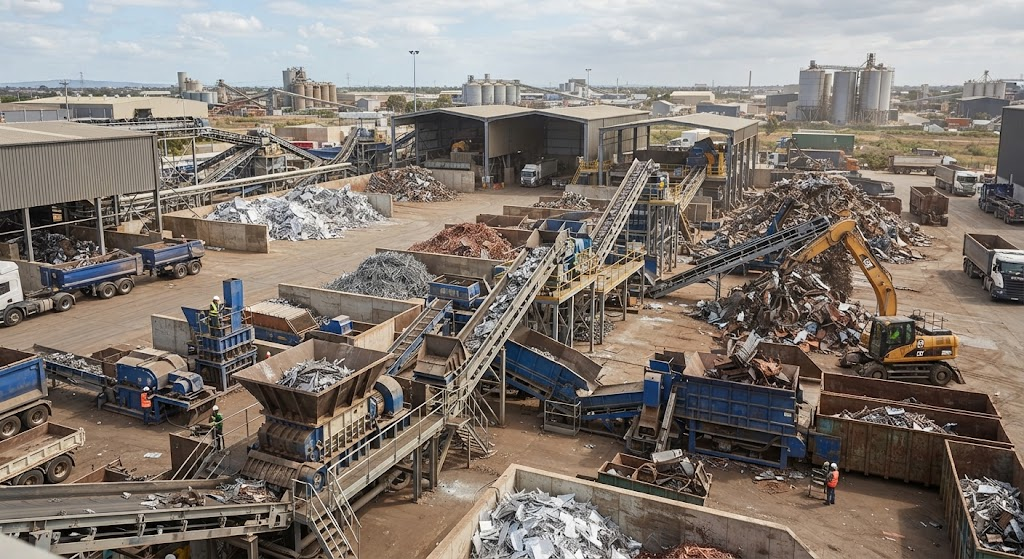
A typical line moves material from intake and preparation to separation, inspection, and shipment. Screening and shredding establish suitable particle sizes and expose metals within composite items; the exact configuration depends on feedstock, contamination, and the specifications of the recovered products.
Material Preparation and Screening
Incoming scrap is inspected and may be screened into size fractions before further treatment. Shredding liberates metal from appliances, vehicles, cables, and electronic waste, while careful control of particle size helps downstream equipment detect and separate individual pieces.
Conveyor-Based Separation
Conveyors carry material through successive stages, where each machine targets a different property. Removing oversized objects and light contaminants early can reduce interference later and help maintain a steadier feed rate.
These initial steps prepare the stream for the facility’s primary metal recovery equipment. A well-designed sequence does not rely on one separator to handle every material.
Sorting Technologies for Ferrous and Non-Ferrous Metals
Once material is prepared, facilities combine physical separation with targeted identification. The choice of technology depends on whether the objective is to recover iron and steel, non-ferrous metals, or specific alloy groups.
Magnetic and Eddy Current Separation
Magnetic separation removes ferrous metals such as iron and steel from mixed streams. Magnets are often positioned above or around conveyors, allowing recovered material to be directed into a separate fraction.
Eddy current separation targets conductive non-ferrous metals, including aluminum, by using a rotating magnetic field to eject them from the remaining material. Together, these methods provide efficient early-stage recovery, but they do not distinguish every alloy or metal type.
Sensor-Based and Optical Sorting
Sensor-based sorting adds material identification to mechanical separation. Optical sorting uses cameras to classify visible features, while induction sorting and other forms of metal detection identify conductive materials. X-ray transmission can distinguish materials by density, and LIBS sensors can classify metals by chemical composition.
Using these systems in sequence can separate aluminum alloys, stainless steel, copper-bearing pieces, and unwanted materials more precisely than a single detection method. The table summarizes common roles in a facility.
| Technology | Primary function | Typical application |
|---|---|---|
| Magnetic separation | Extracts ferrous metals | Steel from mixed scrap |
| Eddy current separation | Separates conductive non-ferrous metals | Aluminum recovery |
| Optical sorting | Classifies visible material features | Sorting prepared fractions |
| LIBS or X-ray sensors | Identifies composition or density | Alloy and metal separation |
Automated Material Recovery and Quality Control
Modern facilities increasingly link sorting equipment with process monitoring to improve consistency across the line. Automated material recovery can combine sensor readings, adjustable settings, and timed air or mechanical ejection to direct identified pieces into the correct product stream.
Air Classification and Contaminant Removal
Air classification separates light materials, such as paper and certain plastics, from heavier metal fractions using controlled airflow. This reduces contamination before finer sorting, though airflow must be matched to the material so valuable small pieces are not carried away with the rejects.
Product Verification and Process Tuning
Recovered streams are checked for unwanted materials and consistency with buyer specifications. Operators can adjust feed rates, screening, sensor thresholds, and ejection timing when changes in scrap composition affect separation performance.
Useful checks throughout the process include:
- Inspecting incoming material for hazardous or oversized items.
- Monitoring separation points for carryover and metal loss.
- Verifying product purity before storage or shipment.
Technology selection is therefore a systems decision: the best results come from matching preparation, detection, and quality control to the materials being processed. A specialist can assess a facility’s feedstock and operating goals to recommend suitable equipment and process adjustments.