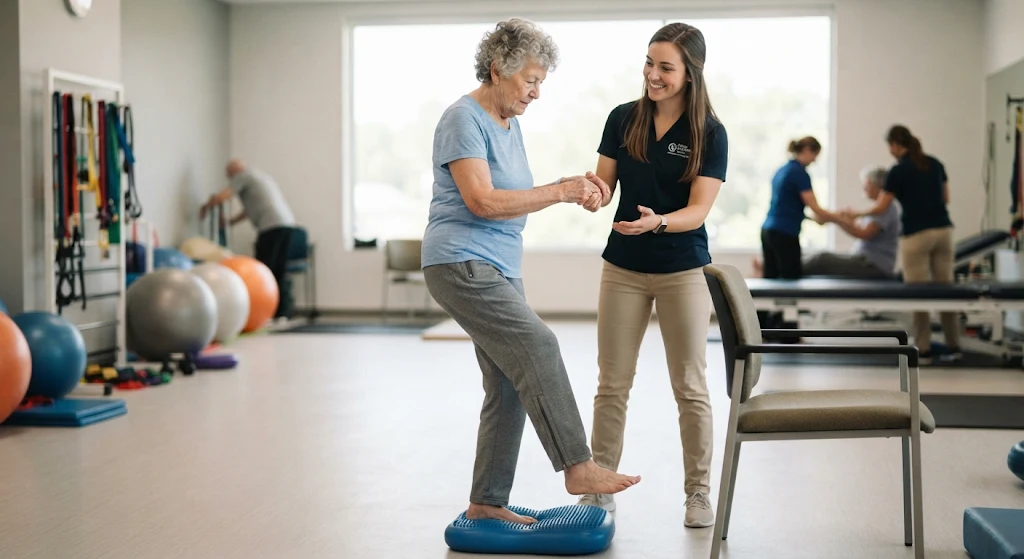
Balance and coordination exercises can help older adults move with greater confidence, support everyday independence, and reduce the risk of falls. A well-rounded routine combines controlled movement, leg strength, flexibility, and practice in different positions. The safest place to begin is beside a sturdy support, with movements adjusted to individual ability.
Understanding Balance Training for Older Adults
Balance exercises train the body to stay steady while standing, stepping, turning, and reaching. They also develop coordination training, stability, mobility, and proprioception—the sense of where the body is in space. These abilities support functional fitness, from rising from a chair to navigating a step.
Falls become more common with age, and public-health estimates indicate that nearly one in three adults over 65 falls each year. Falls can cause fractures or head injuries, but appropriate physical activity can help improve balance and strength. For adults with health conditions, recent falls, dizziness, or significant pain, a clinician or physical therapist can recommend suitable exercises and support.
A secure setup matters more than a challenging routine. Wear stable footwear, clear the floor, and keep a counter or heavy chair within reach; stop if an exercise causes pain, dizziness, or unusual shortness of breath.
Useful balance movements can be grouped by the skills they practise:
- Steady standing: Hold a semi-tandem stance, placing one foot slightly ahead of the other, or practise a supported single-leg stance.
- Controlled stepping: March in place, tap a low step with one foot, or take several side steps beside a counter.
- Leg strength: Try shallow squats, heel raises, small forward lunges, or gentle hip extensions while holding a stable surface.
- Flexibility: Use gentle seated hamstring and standing calf stretches, holding each stretch without bouncing.
Start with a comfortable range and slow, deliberate movement. For example, a supported single-leg hold may last 10 seconds before changing sides; a short set of heel raises or marches can build confidence without rushing.
Choosing Exercises for Different Balance Skills
A balanced plan works on more than standing still. Seated movement can provide a gentler starting point, while standing and moving exercises prepare the body for daily tasks such as dressing, cooking, and turning around.
| Exercise | Skill Practised | Safer Starting Point |
|---|---|---|
| Seated marches | Hip movement and coordination | Sit upright in a firm chair and lift one foot at a time |
| Chair rise and sit | Leg strength and transfers | Use a stable chair and arm support if needed |
| Narrow-stance reaches | Stability while reaching | Stand near a counter and reach within a comfortable distance |
| Three-way hip movements | Hip control and stepping stability | Move one leg forward, sideways, and backward while holding support |
| Tandem stance | Balance with a narrower base | Begin with feet slightly apart rather than heel-to-toe |
Choose a few movements rather than attempting every exercise at once. A routine may include one seated activity, one strength movement, and one supported balance drill; repeat it consistently and increase difficulty gradually, ideally with professional guidance.
Adapting Practice for Safety and Progress
Balance can change with vision, medication, joint stiffness, muscle weakness, or conditions affecting the inner ear. A physical therapist can assess these factors and tailor the level of support, repetitions, and progression. Improvement is often gradual, so stable technique matters more than speed or attempting an unsupported pose too soon.
As confidence grows, coordination can be challenged with gentle reaches or direction changes, but only when the basic movement feels secure. Walking is valuable for general activity, yet it does not replace specific balance practice; combining both with appropriate strength work gives training a broader purpose. Regular movement can also fit into broader wellbeing routines, including low-impact exercise options for seniors and activities adapted to individual interests and abilities.
For personalized exercise choices or help responding to balance problems, consult a healthcare professional or physical therapist.