Copper recycling can return metal to productive use without the quality loss associated with many other recycled materials, but that outcome depends on what enters the furnace. Electrical cable, plumbing, and discarded electronics contain copper alongside coatings, alloys, and other metals, so careful material separation determines whether they can be processed efficiently and consistently.
Separating Copper Scrap By Grade And Composition
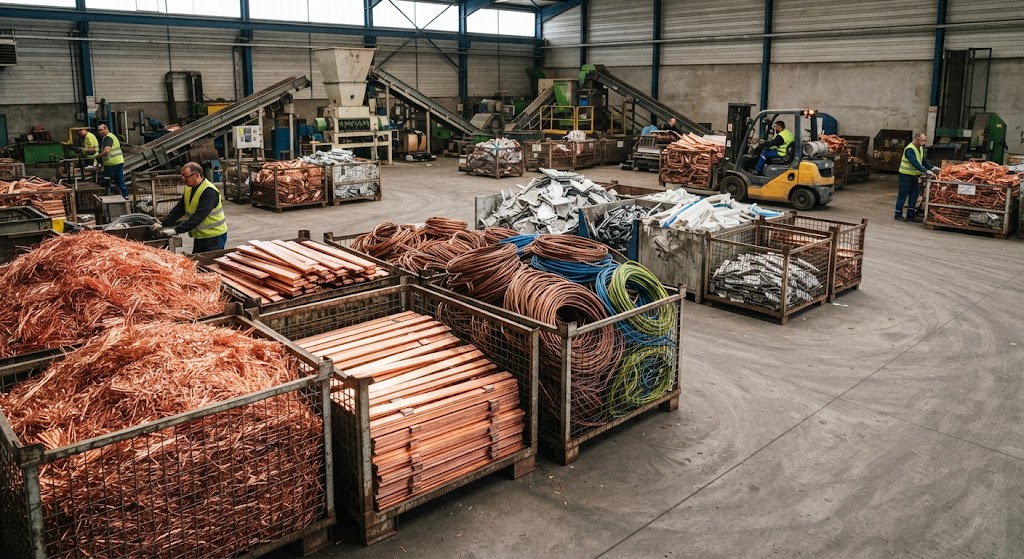
The first decisions in copper recycling happen before melting. Recyclers distinguish clean, high-grade copper from mixed or coated materials so that each stream can be treated according to its composition. A magnet can identify ferrous metals, while visual checks and, where needed, analytical instruments help reveal alloys, insulation, and other contaminants.
These distinctions matter because mixed feedstock can produce unpredictable melts and make it harder to meet product specifications. Keeping similar grades together supports consistent processing and safeguards copper purity from the outset.
Common separation steps address different sources of variation. Their order may change depending on the material and the facility’s equipment.
Sorting Copper Scrap Before Processing
Metal sorting begins with the removal of obviously incompatible items, including steel attachments and non-metal components. Cable may require insulation removal, while electronic scrap can need more complex dismantling or mechanical separation because copper is embedded among several materials.
Shredding can expose hidden components and create more uniform pieces, but it does not replace sorting. When complex scrap is reduced in size, downstream separation systems can more readily divide the copper-bearing fraction from plastics and other metals.
Controlling Contamination In Copper Streams
Paint, oil, dirt, solder, and insulation can interfere with melting or affect the final alloy composition. Cleaning and coating removal therefore serve both quality and process control; suitable mechanical or chemical methods depend on the feedstock and must be managed to avoid transferring contaminants into other streams.
Properly stripped wire is generally more valuable and easier to process than insulated cable. Careful preparation also reduces the risk of unwanted emissions when coatings are heated, making contamination control an operational and environmental measure.
Improving Recycling Efficiency Through Preparation
Once classified and cleaned, scrap may be cut or shredded into a size suited to the next stage. More uniform pieces are easier to handle and can heat more consistently, while reduced bulk can improve transport and furnace charging. However, excessive size reduction uses energy and may complicate the recovery of distinct materials, so equipment settings must match the incoming scrap.
Before melting, facilities can inspect prepared batches and use sampling or compositional analysis to identify material that needs further sorting. This checkpoint helps prevent a small quantity of unsuitable scrap from affecting a larger melt.
Preparation affects the performance of the furnace as well as the quality of its output. The following measures help control that transition from solid scrap to molten metal.
Preparing Copper For Efficient Melting
Scrap composition determines the appropriate furnace practice. Induction furnaces offer controlled heating for suitable operations, while other furnace designs may be selected for different capacities, feedstocks, and production requirements. Copper melts at approximately 1,085°C, but operating conditions vary with the process and charge.
During melting, oxides and other impurities may form a surface layer that can be removed; additional refining may be necessary for demanding applications. Clean, well-characterized input makes these steps more predictable, although separation alone cannot guarantee a particular purity level.
| Preparation Step | Purpose | Processing Benefit |
|---|---|---|
| Grade separation | Groups material by composition and condition | More consistent furnace feed |
| Insulation and contaminant removal | Reduces non-copper material in the batch | Improved quality control |
| Size reduction | Creates manageable, more uniform pieces | More predictable handling and heating |
There is no single preparation route for every facility: the best sequence depends on scrap type, product specifications, and available separation technology.
Maintaining Copper Purity In Recycled Products
After refining, molten copper can be cast into forms such as ingots, billets, or rods, then rolled, drawn, or fabricated for manufacturing. Recycled copper serves construction, electrical equipment, transport, and renewable-energy systems, provided it meets the composition and performance requirements of its intended use.
Testing supports that assurance. Chemical analysis and conductivity checks can verify whether a batch is suitable for a particular application; mixed or lower-grade material may instead require further refining or be directed to products with different specifications.
Recycling can require substantially less energy than producing copper from ore, though the savings depend on feedstock quality and process design. Reliable separation helps preserve that advantage by reducing avoidable reprocessing, limiting contamination, and keeping valuable metal in circulation. In practice, better recovery begins with identifying what the scrap contains—and separating it accordingly.